Researching User Acceptance
Exploring accessibility and usability to prevent cognitively impaired users from rejecting life-saving wearable technology.
Overview
- Role: Co-Lead UX Researcher
- Client: WanderSearch & Victoria University of Wellington
- Duration: 3 Weeks
The Challenge
WanderSearch is a non-profit that provides wearable Electronic Tracking Devices (ETDs) for people at risk of wandering, primarily children with autism and adults with dementia. The core issue: many users actively reject the hardware—removing, hiding, or destroying the life-saving devices.
The Aim
To investigate how we might facilitate cognitively impaired users' acceptance of ETDs without requiring a costly hardware redesign, mindful of the non-profit's limited resources.
Project Impact
Actionable Deliverables: Delivered a suite of low-cost, scalable service and hardware interventions (including onboarding guides and aesthetic modifications) that volunteers could easily implement to drastically increase device retention.
To find out what was really causing the device rejection, we couldn't just look at the hardware in a vacuum. We needed to investigate the WanderSearch service as a whole across three core pillars:
- 1
The Device: Investigated how the device is currently worn to identify areas for immediate, low-cost product improvement.
💡Methods: User Interviews & Desk Research
- 2
The Service Ecosystem: Mapped the onboarding process and stakeholders to define where we could realistically intervene.
💡Methods: Process Mapping, Interviews & Desk Research
- 3
The Broader Context: Analysed how WanderSearch fits into the wider 'SafeWalking' framework to ensure our findings could potentially scale to other tracking devices.
The Device Ecosystem
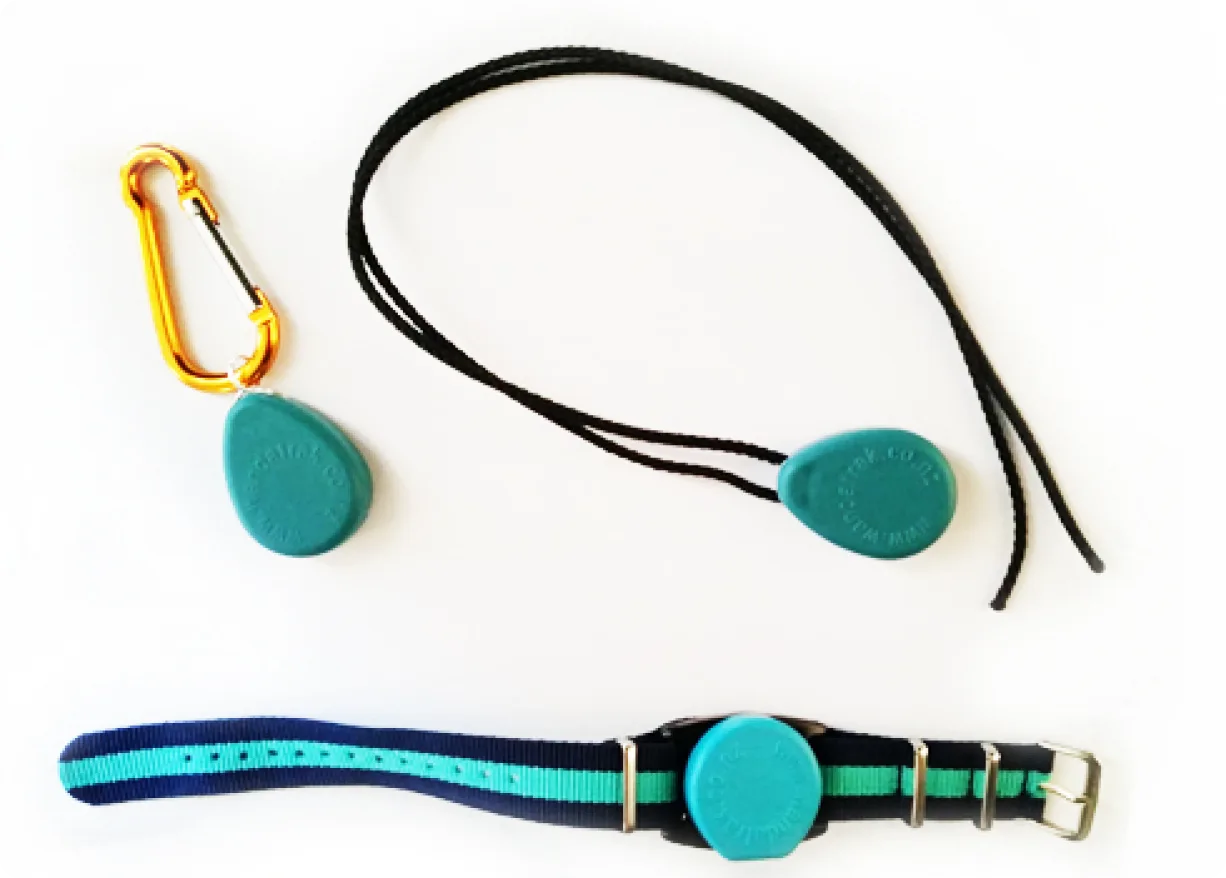
The WanderSearch ETD uses radio frequency technology. It is highly effective, low-cost, and has a 6-month battery life. However, it looks institutional. It is distributed by a decentralised network of independent volunteers across New Zealand.
The standard WanderSearch pendant and watch variations.
The Ethical Constraint & Strategy
💡 Constraint Pivot: Due to university ethics commitments, we were unable to interview the cognitively impaired users directly. To understand the root causes of device rejection, we pivoted our strategy to interview the "proxy users"—the people administering and living with the devices.
We conducted 11 qualitative interviews across four participant groups:
- Caregivers of people with Autism
- WanderSearch Staff and Volunteers
- NGO Volunteers
- Ethics Researchers
Through our interviews, we discovered that volunteers and caregivers were already hacking their own brilliant, independent solutions. Our primary takeaway was that there is no single solution for user acceptance; adapting the device to an individual's lifestyle is more valuable than designing a "shiny new device."

1. Integration over Institutionalisation
Integrating the device into commonly worn objects removes the anxiety of unfamiliarity for users with dementia.
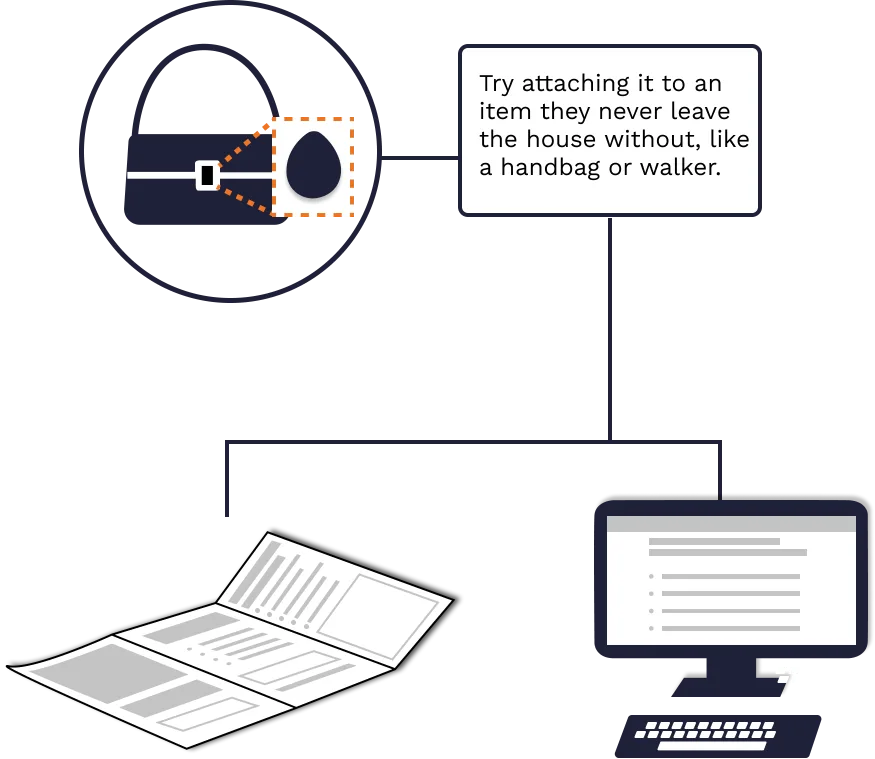
"All old ladies have a nice navy handbag because it matches their every outfit. They won't leave home without it, so it's sewn in the handbag." — Volunteer

2. Aesthetics & Ownership
Autistic users feel a significantly greater sense of ownership when the device's appearance matches their special interests.
"As soon as he saw it was Minecraft colours and he thought it was made just for him—that was it... he was quite happy to put it on." — Caregiver

3. The Power of Language
Users with dementia often don't believe they need a tracking device. Reframing the onboarding conversation is critical for buy-in.
"I think a lot of it is how you approach the conversation and how you phrase things. I think language is really important." — Ethics Researcher

4. The 24/7 Myth
The official recommendation was 24/7 wear, but forcing this caused sensory overload and claustrophobia.
"She can get quite claustrophobic... taking it off and giving her freedom at home if she needs it [helped]." — Caregiver
The Design Reality
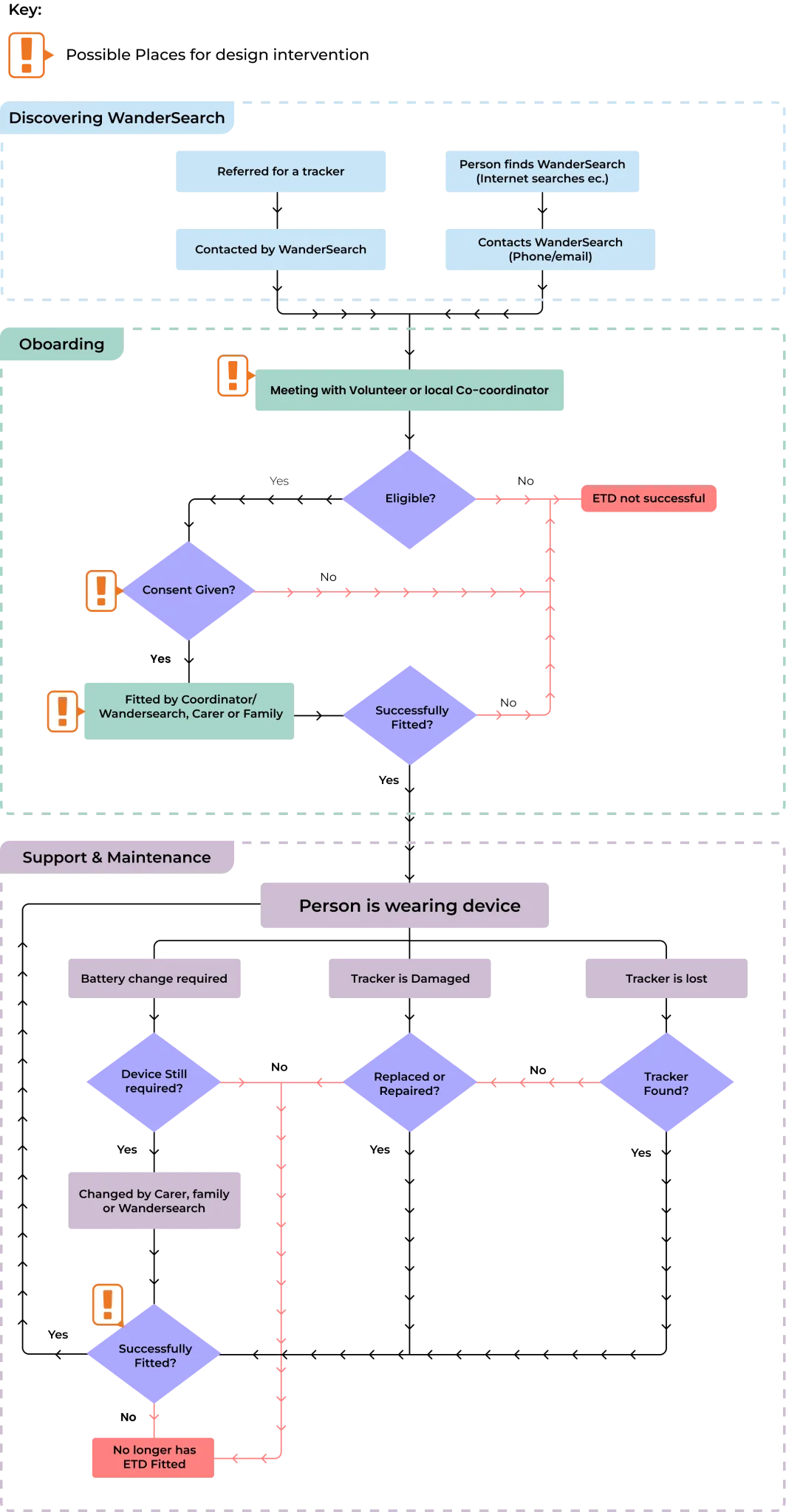
Mapping the service journey revealed that our interventions had to happen during the onboarding phase. Furthermore, we had to design for the reality of the WanderSearch network: Volunteers are often time-poor, have low resources, and lack formal training.
Process mapping to identify key intervention points during onboarding.
Final Service Interventions
Based on our research, we proposed four low-cost, easily deployable solutions focused on collaboration and personalisation:
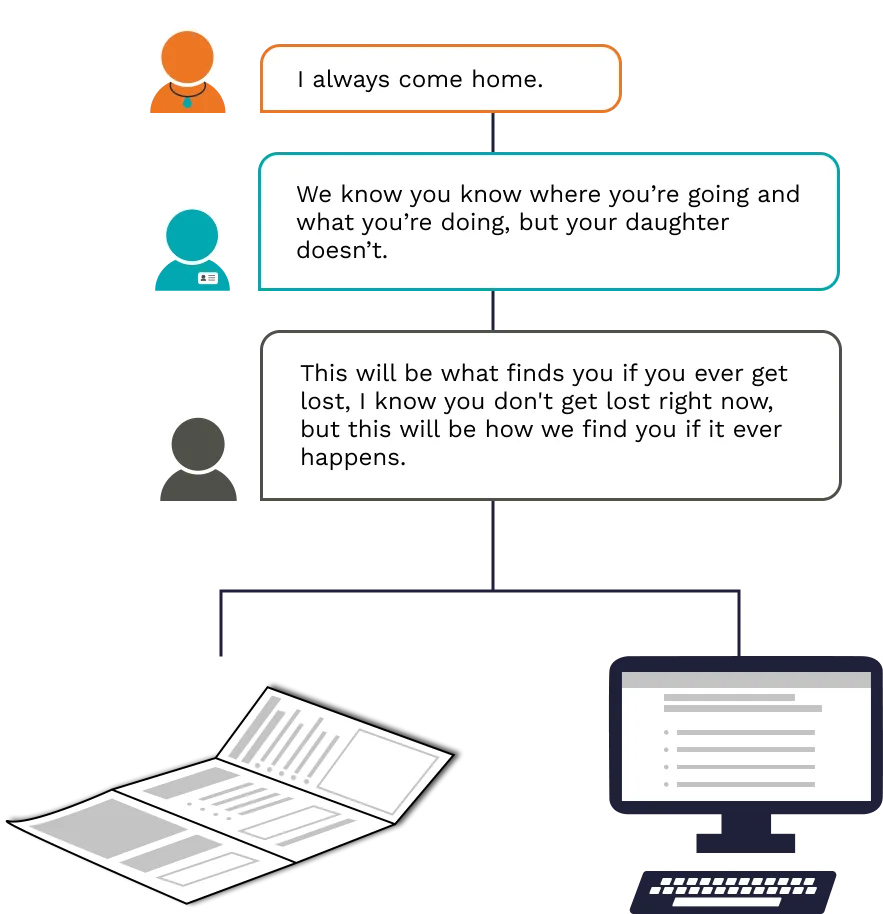
Recommendation 1: Conversation Guide
- Function: Lists users’ common concerns and provides volunteers with scripts to address them effectively.
- Utility: Doubles as standardised training material for new, time-poor volunteers.
- Feedback: Proved highly useful in testing, though noted as not applicable for every single user depending on cognitive decline.
Design Principles Applied:
- Empowering users through collaboration.
- Contextualising the device within the user’s everyday life.
Recommendation 2: "Ways to Wear It" Guide
- Function: Visual prompts listing objects the device can be securely attached to (and how).
- Utility: Doubles as training material for volunteers and sparks adaptation ideas for caregivers.
- Feedback: Positive reception; testing noted that future iterations would need to consider specific use cases to avoid antenna interference.
Design Principles Applied:
- Contextualising the device within the user’s life.
- Encouraging experimentation with attachments.
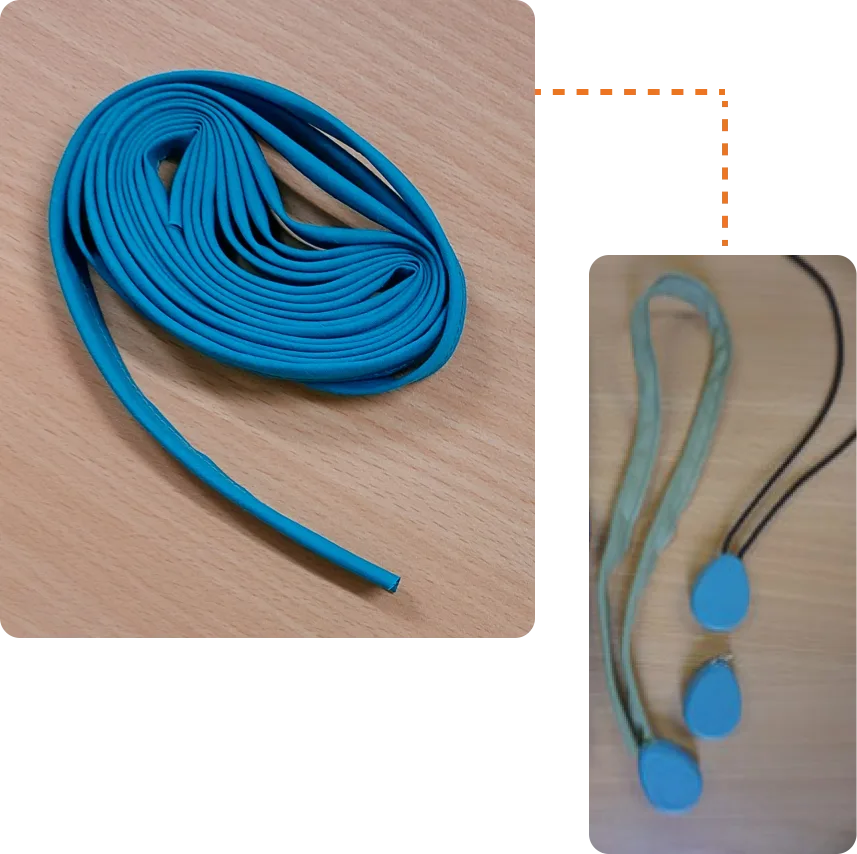
Recommendation 3: Device Sleeves
- Function: Cheap, 3D-printed or silicone sleeves that cover the standard WanderSearch pendant.
- Utility: Extremely cheap to produce and can be manufactured in a wide variety of appealing colours.
- Feedback: Very positive. Test users were unaware a medical device was even in use. Stakeholders were highly interested in how this could scale to other ETD models.
Design Principles Applied:
- Encouraging experimentation with attachments.
- Anticipating and inviting personalisation.
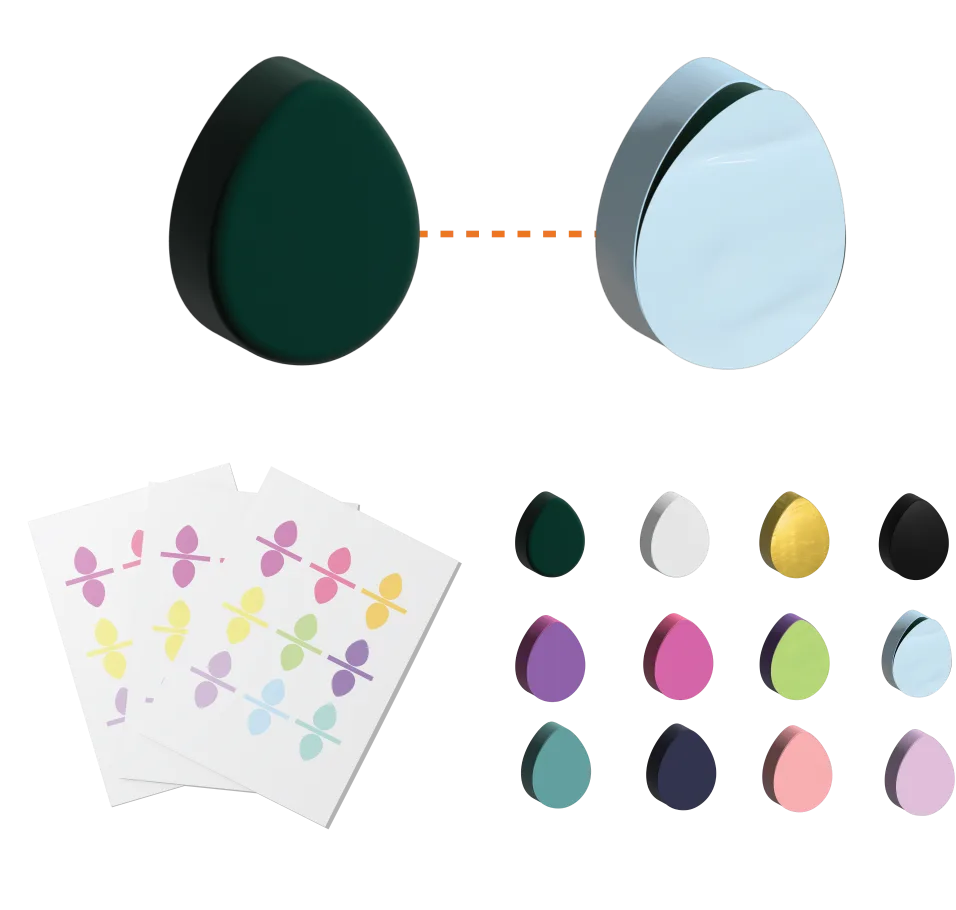
Recommendation 4: Device Skins
- Function: Heavy-duty, low-maintenance coloured stickers that seamlessly cover the ETD.
- Utility: Incredibly easy for volunteers to stock, carry, and distribute; extremely cheap to produce.
- Feedback: Highly positive; caregivers particularly appreciated the low maintenance and negligible cost.
Design Principles Applied:
- Anticipating and inviting personalisation.
- Empowering users through collaboration.
Next Steps
At the conclusion of the 3-week sprint, we handed our data, contacts, and proposed solutions over to a Master's student for further physical prototyping and direct user testing, while simultaneously sharing the service guides with WanderSearch for immediate interim implementation.